Lesson 4. Post-Truth & Information Disorder
Section outline
-
-
Introduction
Nowadays, the media and the internet are flooded with vast quantities of information, which often include a significant amount of false content. This overload of information places the burden on individuals to discern what is true and what is false.
The consequences of widespread misinformation can be significant. If a substantial portion of the population subscribes to factually incorrect beliefs, it may lead to misinformation underpinning political and societal decisions that undermine the overall well-being of the community. Such dynamics highlight the critical importance of accurate information in shaping both collective policy and individual choices.
To effectively combat misinformation and disinformation, it is essential to grasp several key concepts. This includes understanding the mechanisms through which people acquire information and develop their opinions and beliefs. Additionally, it is important to analyse how such false information is created, disseminates, and the reasons why its effective.
Post-Truth
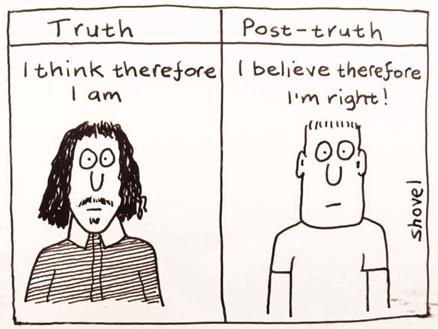
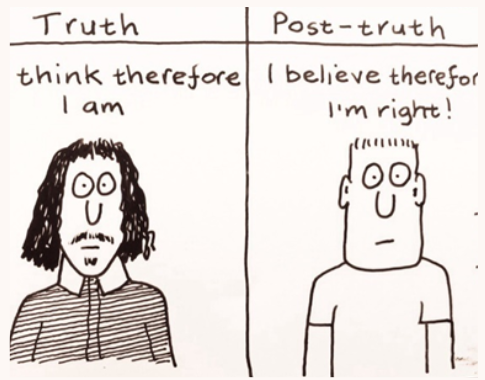
People increasingly believe information that appeals to their emotions and their personal beliefs, as opposed to seeking and accepting information that is regarded as factual and objective
Post-truth is defined as relating to or denoting circumstances in which objective facts are less influential in shaping public opinion than appeals to emotion and personal belief.
Post-truth politics thrived in a polarised environment, where “the idea of truth is already split into notions of my truth vs. your truth”. Fake news further sharpens polarisation, causes corruption and damages “the fabric of democracy”. In other words, existing political and social polarizations are reinforced by fake news.
Information DisorderThe term "fake news" fails to encompass the full spectrum of misleading content, as some such content is not necessarily false. To address this limitation, the concept of "information disorder" has been introduced, reflecting a complex phenomenon characterized by varying degrees of deception and harm. There is low-level information pollution, which is relatively benign, and high-level information which is profoundly misleading. Information disorder is classified into three categories.
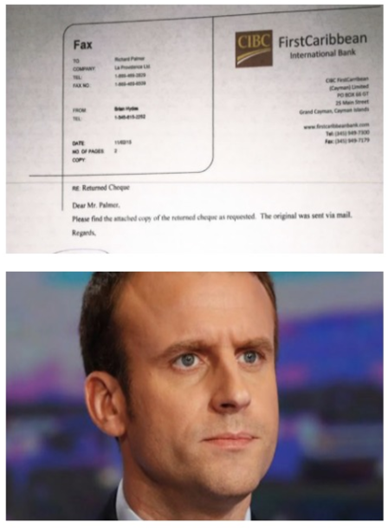 1. Disinformation: Disinformation is content that is intentionally false and shared to cause harm. Examples include fabricated or manipulated/doctored audio-visual content, conspiracy theories or rumours.
For instance, during the 2017 French Presidential election a rumour spread on social media that Emmanuel Macron had a secret offshore account in the Bahamas. Documents circulated online such as the contract with the bank (including Macron’s signature and the contact information of the bank) were all proved to be fabricated. The aims was to discourage French voters from voting Macron.In the last three years, numerous misinformation were spread about the war in Ukraine. Snopes article UKRAINE: New Crisis, Grimly Familiar Disinformation Trends exposes a number of re-hashed videos, offensive memes, fear-mongering conspiracy theories as disinformation.
2. Misinformation: This happens when false information is shared, but no harm is intended. When disinformation is shared by a person who doesn’t realise that it is false or misleading, it turns into misinformation. This includes inaccurate photo captions, dates, statistics, translations.
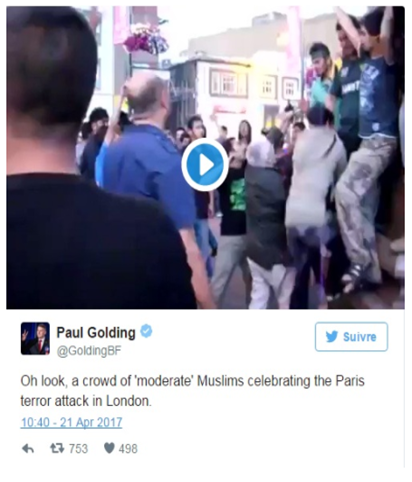 Example: In 2017, three French Police officers and a tourist were shot by an ISIS fighter. The day after the misfortunate event, a video posted by Paul Golding, the leader of a far-right British political organization, claimed that London Muslims were celebrating the terrorist attack. In fact, the video was originally posted on YouTube in 2009 and showed a group of Pakistanis celebrating Pakistan's victory in a cricket match.
3. Malinformation: Sharing genuine information to cause harm often by moving information that should remain private to the public sphere or malicious distortion of genuine information such as context, date or time.
Example: In 2016, the email account of John Podesta, chair of Hillary Clinton's presidential campaign, was hacked and his emails were released by Wikileaks. Podesta refused to confirm or deny the emails' authenticity. The investigation by U.S. intelligence agencies reported there was no evident forgery. Most of the emails reflected ordinary campaign communications, however the leak shed light on the inner workings of the presidential campaign.
Types of Information DisorderManipulated Content
This is when genuine content is tampered with or doctored in some way to decieve.
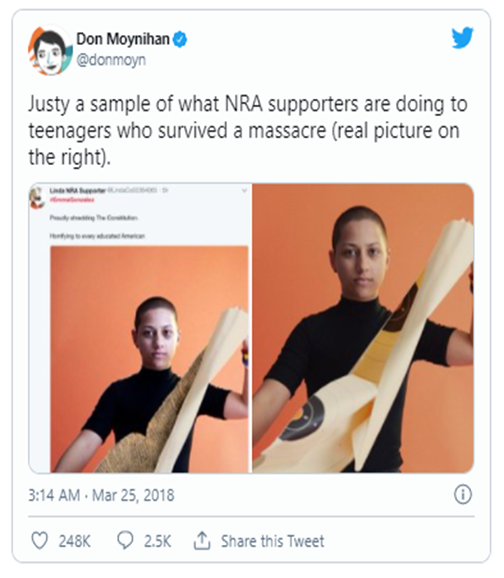
Example: Student Emma Gonzalez and three of her peers who survived a school shooting in Florida were photographed to appear on the front cover of Teen Vogue and the magazine created a video of Gonzalez ripping a gun target in half. This video was altered so it appeared Gonzalez was ripping the US Constitution in half.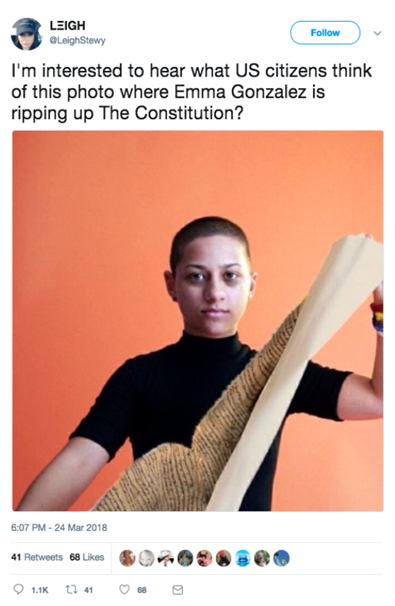
Fabricated Content
This category describes content which has no factual basis and is entirely fabricated.
Example: In 2012 a video posted on YouTube by MrNuclearCat, shows an eagle swooping down, snagging a baby off the ground, then dropping him a few seconds later. The video was created by three students of a Montreal design college as part of a class assignment to create content that might successfully hoax viewers.Deepfakes
Fabricated content, which is used to manufacture a video and audio, creating convincing but false representations of people.
Misleading Content
Authentic information presented out of context. It can come in many forms such as the selection of a partial segment from a quote to support a point, creating statistics that support a particular claim.
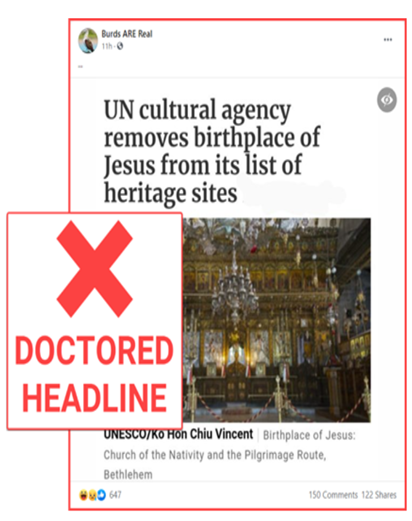
Example: Claims that UNESCO removed the birthplace of Jesus from its World Heritage List omitted the context that the site was merely removed from the "in danger" list due to restoration efforts.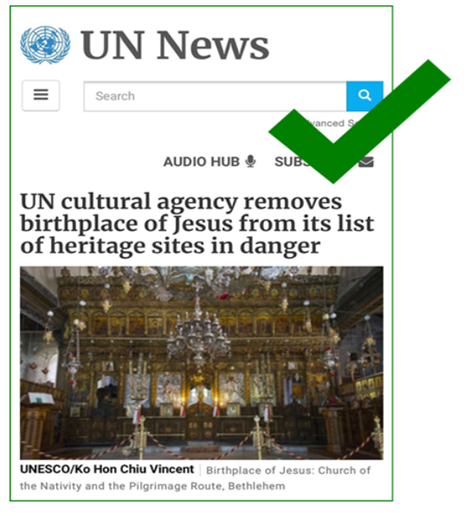
False ContextContent that is genuine but has been reframed and shared with false contextual information.
Example: In 2019, images of rubbish in Hyde Park were incorrectly linked to a global-warming protest, though the event had no connection to the protest.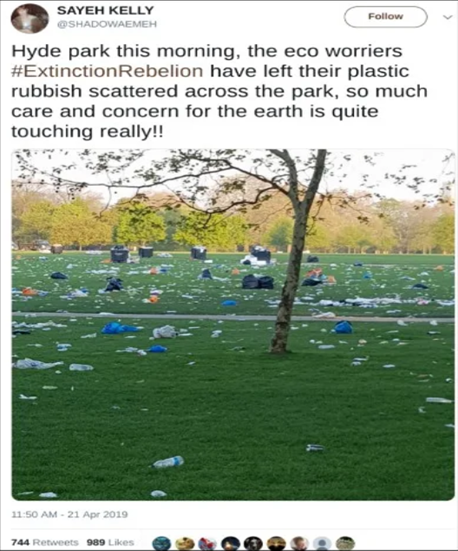
False Connection
It is a technique called clickbait, that is used for attracting attention and driving clicks through rather misleading and sensational headlines, visuals, or captions.
Example: Claims of “houses for £1 in Italy” often omit significant renovation costs (obligatory), misleading potential buyers.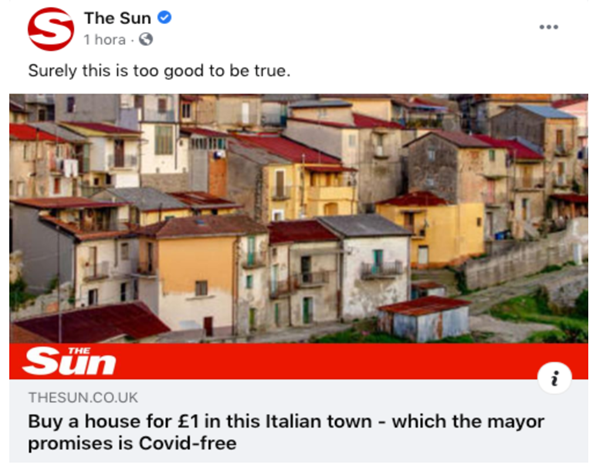
Imposter Content
This category describes impersonation of genuine sources. For instance, the logo of a well-known brand or name is used alongside false content.
Example: An imposter website mimicking the Belgian newspaper Le Soir falsely claimed that Macron’s campaign was funded by Saudi Arabia, spreading misinformation during the 2017 French elections.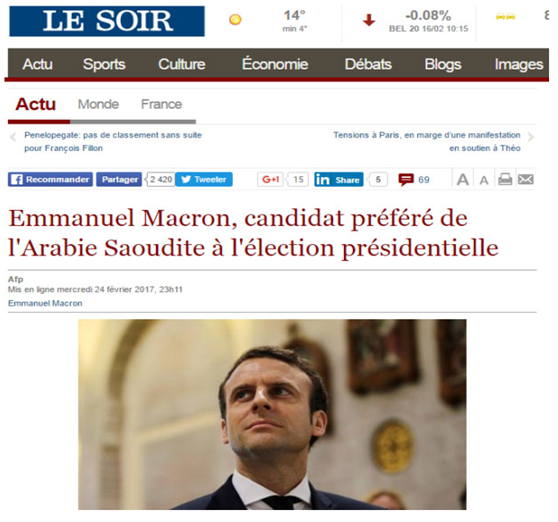
Conspiracy Theories
Conspiracy theories attempt to explain significant events and circumstances as the malicious acts of secret and powerful people and groups.
Example: Unfounded claims about COVID-19’s origins in a Chinese lab persisted despite scientific evidence refuting these theories.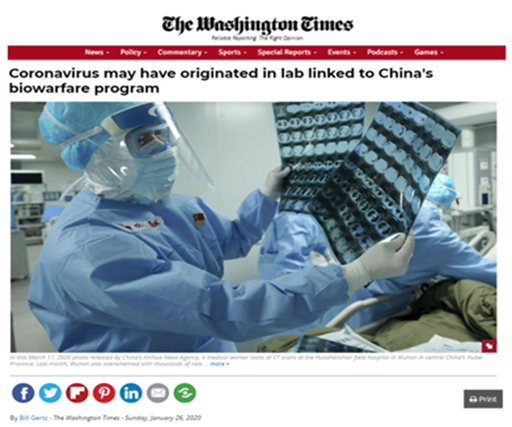
Satire and Parody
Generally, news satire and news parody are not included within the information disorder typology because they have no intention to mislead or cause harm. However, they have the potential to fool people. When it is shared and re-shared, the original context of the content can get lost.
Example: A parody article naming Kim Jong-Un as the "Sexiest Man Alive" in 2012 was mistaken as genuine by some news outlets.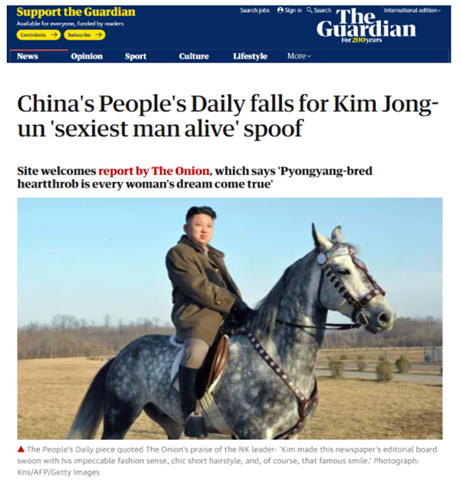
Addressing Information Disorder
Navigating misinformation requires critical thinking skills and combatting information disorder requires a multifaceted approach:
- Education: Promoting media literacy to help students critically approach and evaluate content.
- Regulation: Different platforms should implement measures that reduce the spread of misinformation.
- Technology: Developing tools to detect and flag fabricated content.
ConclusionInformation disorder poses significant challenges in the digital age. By understanding its types and mechanisms, students can become more aware and reduce the harm caused by such false content. Therefore, as we all face these issues daily it is important to foster critical thinking and media literacy.
-
Please find here the PowerPoint presentation for Lesson 4, entitled Post-Truth & Information Disorder.
-
- Understanding Information disorder – examines the complexities of our polluted information ecosystem, emphasizing the importance of precise terminology and definitions in addressing challenges like disinformation, misinformation, and malinformation.
- In this short lecture about post-truth, journalist Charles Sykes tackles questions such as: Do facts matter anymore? Do voters care about falsehoods? What is the future of democracy in a world of "fake news"? When did any news we don't like become "fake news"? How can we ever know who to believe? What's happened to us, and what can we do to fix it?
-
Practise your knowledge on post-truth and information disorder by taking this short, 10 question quiz.
-
Curriculum File PDF
This lesson plan explores the challenges posed by information disorder in the digital age. It examines how false and misleading information spreads and explores different categories of information disorder. It also goes into the notion of post truth Students will investigate real-world examples, explore different tools for verifying such content, and discuss the ethical and societal consequences behind misinformation. The goal of this lesson is to enhance critical thinking and media literacy skills to help students navigate a world of information disorder.
-