Lesson 10. What is Critical Thinking?
Section outline
-
-
Introduction
Critical thinking is an essential skill for media literacy – and generally distinguishing the truth – that involves the ability to analyze information, evaluate evidence, and form reasoned conclusions. Thereby, it is essential in a technocratic society such as ours where there are so many information and it is difficult to know which ones are false and which are true; it is also a fundamental skill in a democratic society, which should strive at providing balanced arguments to its members and enable them to make informed decisions – thereby applying reasoning, choices, decisions and conclusions. It is a disciplined process that requires active engagement with ideas, allowing individuals to think clearly and rationally about what to believe or do. This text explores the origins of critical thinking, significant figures who have contributed to its development, practical applications, and its critical role in society.
Origins of Critical Thinking: Socrates, the Midwife of Critical Thinking
The roots of critical thinking can be traced back to ancient civilizations, particularly in Greece. Ancient Greeks lived in separate city-states called polis, and we can say that critical thinking was born in one of them, in ancient Athens, from 5th to 3rd century BCE. Philosophers like Socrates, Plato, and Aristotle laid the groundwork for systematic inquiry and rational thought. Socrates – the teacher of Plato, who in turn taught Aristotle – could be credited as the father of the critical thinking.
Namely, before Socrates, ancient Greeks sought truths about the world from their poets or prophets, such as Homer, generally believing that they are the ones who hold the keys to knowledge and are inspired by divinity. Socrates claimed that truth is not poetic, symbolic or abstract, but that it can be reached through a rational conversation where, thorough a dialogue involving questions and answers, we gradually narrow the subject down to its most essential notion – the truth. In other words, Socrates claimed that he does not know the truth beforehand, but that he develped a model of rational reasoning, which he called Socrates called the “midwife method,” probably because he was the son of a midwife. He believed that the truth was already in a person's mind, and it was only necessary to extract it from there and help it be born. This is known as the Socratic Method – a form of cooperative argumentative dialogue that stimulates critical thinking by asking and answering questions to stimulate deeper thought and insight. This method emphasizes the importance of questioning assumptions and seeking clarity.
While Socrates did not write anything himself, we know of his teachings through his disciple Plato, as Socrates is the main character in several of his dialogues. In one of those, called Theaetetus (4. C. BCE), Socrates describes his midwifery method as follows:
Well, my art of midwifery is in most respects like theirs; but differs, in that I attend men and not women, and I look after their souls when they are in labour, and not after their bodies: and the triumph of my art is in thoroughly examining whether the thought which the mind of the young man brings forth is false and lifeless, or fertile and true. And again I resemble the midwives in being barren of wisdom, and the reproach which is often made against me, that I ask questions of others and have not the wit to pronounce upon any subject myself, is very just--the reason is, that the god compels me to be a midwife, but has not allowed me to bring forth. I myself, then, am not particularly wise, nor have I anything to show which is the invention or birth of my own soul. But of those who converse with me, some at first appear utterly stupid; and all, as our acquaintance ripens, if the god is gracious to them, make astonishing progress; and this in the opinion of others as well as in their own. It is quite clear that they never learned anything from me; the many fine discoveries to which they give birth are of their own making. But to me and the god they owe their delivery.
(Theatetus 150b-150d, p 244)
During the Renaissance, the emphasis on humanism fostered further development of critical thinking. Thinkers like Descartes and Locke introduced ideas of skepticism and empiricism, encouraging individuals to question accepted truths and seek knowledge through observation and reason. The Enlightenment period saw the emergence of rationalism and scientific inquiry, which further promoted critical thinking as a foundation for knowledge.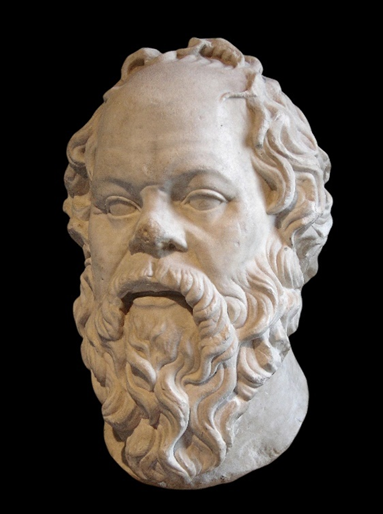
Marble head of Socrates in the Louvre (1st century)
In the 20th century, John Dewey advocated for experiential education and reflective thinking, stressing the importance of critical thinking in problem-solving and decision-making. Dewey argued that critical thinking is crucial for effective citizenship and personal development.
Nowadays, figures such as Edward de Bono have contributed to the understanding of creative and lateral thinking by highlighting the necessity of thinking beyond traditional logic to solve complex problems. Additionally, thinkers like Daniel Kahneman and Richard Thaler have examined cognitive biases and decision-making processes, clarifying the psychological aspects of critical thinking.
Practical Applications of Critical Thinking
Critical thinking is applicable in various contexts, including education, business, healthcare, and everyday life. In education, critical thinking skills enable students to analyze texts, assess arguments, and develop their perspectives on complex issues. For instance, students might critique a historical event by examining multiple viewpoints, considering the evidence, and formulating their conclusions.
In the business realm, critical thinking is essential for strategic planning and problem-solving. Leaders utilize critical thinking to evaluate market trends, assess risks, and make informed decisions that drive organizational success. For example, a company facing declining sales may use critical thinking to analyze customer feedback, identify underlying issues, and develop effective marketing strategies.
In healthcare, critical thinking is vital for diagnosis and treatment planning. Medical professionals must evaluate symptoms, consider various possible conditions, and determine the best course of action. For instance, a doctor might analyze a patient’s medical history, conduct tests, and weigh the benefits and risks of different treatments before making a recommendation.
Political Role of Critical Thinking in SocietyCritical thinking plays a pivotal role in fostering informed and engaged citizens. In a democratic society, it is crucial for individuals to evaluate information critically, especially in the age of misinformation and rapid technological advancement. Critical thinking empowers citizens to discern credible sources, analyze political arguments, and make informed choices during elections.
Moreover, critical thinking contributes to social progress by encouraging dialogue and understanding. It fosters an environment where diverse perspectives are valued, allowing for collaborative problem-solving. For example, community organizations often rely on critical thinking to address social issues, engaging stakeholders in discussions that lead to effective solutions.
Games and Activities to Enhance Critical Thinking Chess.com – Free online platform for playing chess that enhances strategic thinking, foresight, and planning. Chess.com is a website dedicated to chess and the millions of chess players around the globe who love the game. It is a place to show who you are, share what you think, improve your chess game, and enjoy every aspect of chess!
 The Talos Principle is a payable philosophical first-person puzzle game set in a contradictory world of ancient ruins and advanced technology. Tasked by your creator with solving a series of increasingly complex puzzles, you must decide whether to have faith, or to ask the difficult questions: Who are you? What is your purpose And what are you going to do about it?
 Spent is an online game about poverty and homelessness. It was developed by advertising agency McKinney for their pro bono client Urban Ministries of Durham, a nonprofit organization in Durham, North Carolina that provides services to those in poverty.
Spent is based on the concept of budgeting and the various challenges one has to face in day-to-day life. While playing the game, the player will face multiple difficult scenarios and has to make crucial decisions that will directly impact their income (in the game).
 Numberdyslexia.com offers a nice collection of online games to improve your critical thinking skills, including the classical ones such as Sudoku, Tangram etc.
 Brainstorm - Critical thinking is all about making decisions based on analytical observation and this game allows individuals to Brainstormand find answers to challenging questions. A maximum of four players can join and compete with each other to complete small tasks and objectives ahead of every other player. The players would need to push their brains to their limits which means that this game will stimulate their brains and let them exercise critical thinking skills.
ConclusionIn conclusion, critical thinking is a vital skill with deep historical roots and significant implications for personal development and societal progress. By understanding its origins, recognizing influential thinkers, and applying it in various contexts, individuals can enhance their ability to think critically and contribute meaningfully to their communities. Engaging in exercises designed to foster critical thinking will further empower students and citizens alike to navigate the complexities of modern life.
-
Please find here the PowerPoint presentation for Lesson 10, entitled What is Critical Thinking?
-
- 16 Best Free Online Critical Thinking Courses – from various universities around the world.
- Thinking Fast and Slow, by Daniel Kahneman
- Argument Wars (iCivics) – a game that engages players in crafting arguments for real Supreme Court cases.
- Top 10 Online Resources to Improve Your Critical Thinking Skills!
-
Practise your knowledge about Critical Thinking by taking this short, 10-question quiz.
-
Curriculum File PDF
This lesson plan explores the essence of critical thinking, tracing its origins, significant contributors, and practical applications. Participants will learn how critical thinking enables individuals to analyze information, evaluate evidence, and form reasoned conclusions. Using historical examples like Socrates' Socratic Method and contemporary applications in various fields, the lesson highlights the importance of critical thinking in navigating modern societal challenges. Interactive discussions and activities will enhance participants' ability to think clearly, rationally, and critically in diverse contexts.
-