Lesson 14. Analyzing News Articles
Section outline
-
-
Nowadays the people are surrounded with bunch of news, associated with a variety of topics of their interest. However, it is very important, especially for the sensitive topics, to be able to read them and understand them properly. For this purpose, it is essential for the people to have the skills to detect the accuracy and the relevance of the source and the text and to critically read and analyze the content of the article. These skills are necessary because the processing of the information is a base for the further acts of the people, especially for the issues that they are reading about.
Speaking about the critical reading, it can be defined as an “active way of reading. It is a deeper and more complex engagement with a text. Critical reading is a process of analyzing, interpreting and, sometimes, evaluating. When we read critically, we use our critical thinking skills to question both the text and our own reading of it.” (Duncan)
For this purpose, it is important to be considered how the news article is structured; which is the source that is sharing the news article; what from the shared information is relevant and confirmed and what is someone’s opinion.
Hence, this textbook is providing the brief information about the structure of the news article, the elements of the article, source relevance and evidence and the differentiation between opinions and facts.
Structure and elements of a news article
There could be a variety of structures that may be used for the development and writing of a relevant and comprehensive news article.
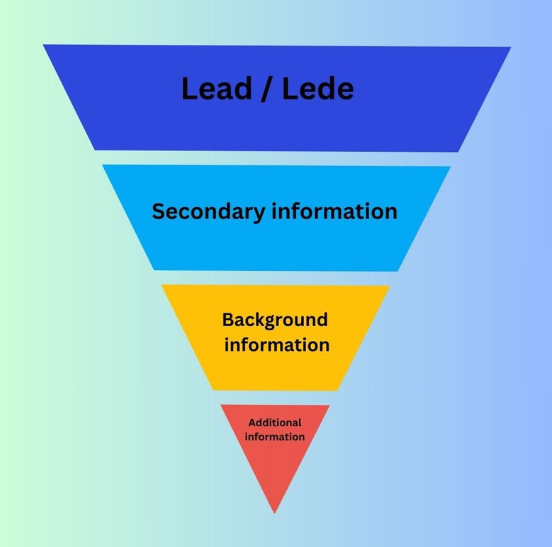
However, nowadays the most common and well-known structure of the news articles is the so called “inverted pyramid”. The inverted pyramid structure presents the composition of the news from most to least important information (see University of Hull 2024; Telg & Lundy 2015.)This structure is mostly used in order to firstly grab the attention and focus of the reader and to continuously provide the additional information that will clarify the entire text of the news.
The inverted pyramid structure of the news is explained as following:
- It begins with the main paragraph which is well known as lead or lede. This paragraph is short and includes the most important information about the news and the main point of the story;
- The next one is the secondary information. This information includes further description of the lead paragraph with additional statistics and other relevant data;
- The following part of the pyramid is containing the background information. Here are encompassed all the things and events that are leading to the main point/event of the news;
- As a last part is the additional information. These are all the information that are supporting the main story and were not previously explained.
All of the abovementioned parts of the inverted pyramid also contain a few elements that they have to give an answer too.
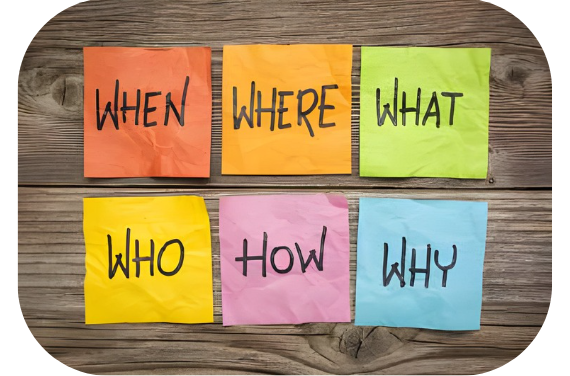
Namely, this structure for news writing has to answer to the “five Ws and one H” (see News Writing Fundamentals).
These are actually different question words through which the news article has to provide the answers that will give the comprehensive information regarding the topic/event.
More precisely, the news article has to give the answers to:Who? What? When? Where? Why? and How?
 Some of the authors who work on these issues consider that in the lead part of the pyramid there has to be offered the most important information regarding the article and to be followed with the secondary information.
All in all, the news article, in order to be relevant has to follow the specific structure of presenting the information by emphasizing the most important information at the beginning and to be added all relevant sources that should follow. These facts that follow are very important and contribute to the critical reading of the readers, by offering them the facts that will serve them for further consideration of the data presented in the news article.
Evaluating sources and evidence
Fake news become more frequent nowadays and there is a necessity for the critical reading in order to avoid the share of such information broader or to act according to it. Therefore, being able to detect the relevant sources of evidence is crucial.
One of the ways how to detect and evaluate the real source and evidence is the SIFT mechanism, created by Mike Caufield (see: Evaluating News Resources).

By following the SIFT the purpose is that the reader is enabled to reconsider the source from where he/she is getting the information; to consider how much the source is relevant and could the reader trust the source or not; to be able to search for other sources that cover the same news and to analyze how much the presented information corelates with the real setting and the accuracy of the original data.
Differentiating between news and opinion
From the above-mentioned structure of the news article and the interpretation of the evidence it is visible that when we speak about the difference between the news and opinion we actually make a differentiation between facts and opinion.
The news is based on the facts that could be checked and verified as true, which is not the case with the opinion. The opinions are defined as personal stances, views and judgements of the author who is writing the certain text regarding the issue that is elaborated within the text. Related to the news, they are considered as factual because their evidence has the proven data that “[…] answer the questions of who, what, where, when, why and how […]”(see Izen 2021)
The differentiation between the news (facts) and opinion is essential for building the critical reading and helps the readers to better understand the real context of the issues they are reading about. Additionally, this differentiation helps the reader to reconsider the exposed opinions and not to take them as an absolute truth.
- It begins with the main paragraph which is well known as lead or lede. This paragraph is short and includes the most important information about the news and the main point of the story;
-
Please find here the PowerPoint presentation for Lesson 14, entitled Analyzing News Articles: Critical Reading in the Information Age.
-
-
Practise your knowledge about Analysing News Articles by taking this short, 10-question quiz.

-
Curriculum File PDF
This lesson plan introduces to the participants how to critically read and analyze news articles and written media. The students will learn about “inverted pyramid” which gives an overview of the structure and the elements that an article should comprise. Additionally, the incorporated method for investigating the news sources assists in better understanding the evaluation of the sources and the relevance of the evidence. This lesson will serve as a good basis to help the students identify the difference between plain facts and opinion in written media.
-