Lesson 12. Logical Fallacies: Spotting and Avoiding Flawed Reasoning
Section outline
-
-
Introduction
Logical fallacies are errors in reasoning that undermine the validity of arguments, often making them appear persuasive while lacking logical foundation. They often appear convincing because they exploit emotional appeals, social biases, or flawed logic.
Understanding fallacies is a key component of critical thinking, as it equips individuals with the ability to evaluate arguments and distinguish sound reasoning from flawed logic. By identifying common fallacies like ad hominem attacks or straw man arguments, students can learn to navigate persuasive rhetoric and avoid being misled by faulty claims. Teaching logical fallacies fosters intellectual discipline, helping students question assumptions, seek evidence, and think independently. Moreover, it enhances their communication skills, enabling them to present their ideas clearly and defend them effectively against criticism.
In an era dominated by misinformation and polarized debates, recognizing fallacies empowers students to engage thoughtfully with complex issues and make informed decisions. This skill is not only critical for academic success but also essential for active participation in civic life. Teaching logical fallacies helps cultivate a generation of discerning, reflective, and responsible thinkers.
Common Logical Fallacies
- Straw Man Fallacy: Misrepresenting someone's argument to make it easier to attack.
Example: “You’re against space exploration? So you’re okay with ignoring scientific progress?” - Ad Hominem: Attacking the person instead of the argument.
Example: “You can’t trust their opinion on climate change - they didn’t even finish college!” - Slippery Slope: Assuming one step will inevitably lead to a negative chain of events.
Example: “If we allow one late submission, soon no one will follow deadlines.” - Appeal to Authority: Assuming something is true because an authority figure says so.
Example: “This product must be great—an athlete endorses it!” - False Dilemma (Either/Or Fallacy): Presenting only two options when more exist, forcing an oversimplified choice.
Example: “You’re either with us or against us.” - Bandwagon Fallacy: Assuming something is true or good because it is popular or widely accepted.
Example: “Everyone else is buying this product, so it must be the best.” - Red Herring: Introducing an irrelevant topic to divert attention from the original issue.
Example: “Why worry about climate change when there are people who don’t have enough to eat?” - Nirvana Fallacy: Rejecting a solution because it isn’t perfect, ignoring that it may still be effective.
Example: “Why bother with renewable energy? It can’t completely replace fossil fuels right away.” - Appeal to Novelty: Claiming something is better simply because it is new or innovative.
Example: “This new diet plan must work better - it was just developed this year!” - Post Hoc Ergo Propter Hoc (False Cause): Assuming that because one event followed another, it was caused by it.
Example: “I started wearing this bracelet, and now my grades are better - it must be lucky!” - Middle Ground Fallacy: Assuming the compromise between two positions must be correct, regardless of evidence.
Example: “Some say the Earth is flat, others say it’s round - the truth must be somewhere in between.” - Appeal to Tradition: Arguing something is better or correct because it’s always been done that way.
Example: “We’ve always held this event outdoors; we can’t change it now.” - Hasty Generalization: Drawing a conclusion based on insufficient or unrepresentative evidence.
Example: “I met two rude tourists from that country - everyone there must be rude.” - Circular Reasoning: Using the conclusion as a premise, assuming what you’re trying to prove.
Example: “I’m trustworthy because I always tell the truth, and you can trust me to say that.” - Appeal to Emotion: Using emotional appeals instead of logic to persuade.
Example: “Think of all the starving children - don’t you want to donate today?” - Begging the Question: Assuming the truth of the conclusion within the argument.
Example: “The law is good because it’s the law.” - Tu Quoque (You Too Fallacy): Dismissing criticism by pointing out the critic’s hypocrisy.
Example: “You say I shouldn’t text while driving, but I saw you do it last week!” - Equivocation: Using ambiguous language to mislead or misrepresent.
Example: “The sign says ‘Fine for Parking Here,’ so parking here must be fine!” - Appeal to Ignorance: Claiming something is true or false because it hasn’t been proven otherwise.
Example: “No one has proven aliens don’t exist, so they must be real.” - Composition Fallacy: Assuming what’s true of the parts must be true of the whole.
Example: “Each player on the team is excellent, so the team must be unbeatable.”
Sophisms and Paradoxes
Sophisms and paradoxes are, in essence, logical or intellectual puzzles and contradictions that have puzzled philosophers, logicians, and scientists throughout history. These are problems that create confusion and challenge conventional thinking.
The term paradox originates from Greek, combining para (contrary) and doxa (opinion or belief). A paradox is a statement or set of statements that lead to contradictions or defy intuition. Paradoxes stimulate critical thinking by exposing the limitations of human judgment and reasoning tools. Despite their perplexing nature, paradoxes have often catalyzed significant intellectual advancements. They have sometimes required the development of new mathematical principles or physical laws to resolve conclusions that initially seemed "obviously unacceptable."
The word sophism also has Greek origins, deriving from sophia (wisdom). However, sophism carries a negative connotation. It refers to a deceptive or specious argument crafted either to appear intellectually superior or to mislead others. Sophisms were crafted by the sophists in ancient Greece, whose name also stems from sophia. While sophists could be interpreted as "wise ones," their reputation for cunning and manipulation has given the term a less flattering meaning—akin to "intellectual tricksters." These individuals were intellectual magicians, employing rhetorical tricks and illusions to impress or deceive, akin to pulling rabbits out of hats in debates.
In summary, while paradoxes challenge intellect and intuition to push boundaries of knowledge and understanding, sophisms often exploit rhetoric and reasoning for less noble purposes, focusing more on appearances and persuasion than on genuine insight.
One of the early and well-known sophisms is the so-called Epimenides Paradox.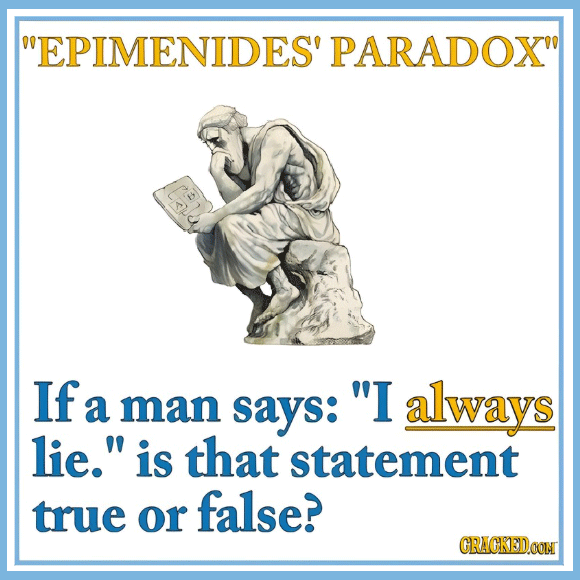
Ancient Greek philosopher Epimenides created a puzzle that goes: All Cretans are liars. Is this statement true or not? If all Cretans lie, and Epimenides is a Cretan, then his statement that all Cretans lie must be true. But if this is true, then not all Cretans are liars, creating a contradiction. Conversely, if we conclude that not all Cretans lie and his statement is false, then it must actually be true that all Cretans lie. This creates an endless loop of reasoning, with no resolution.
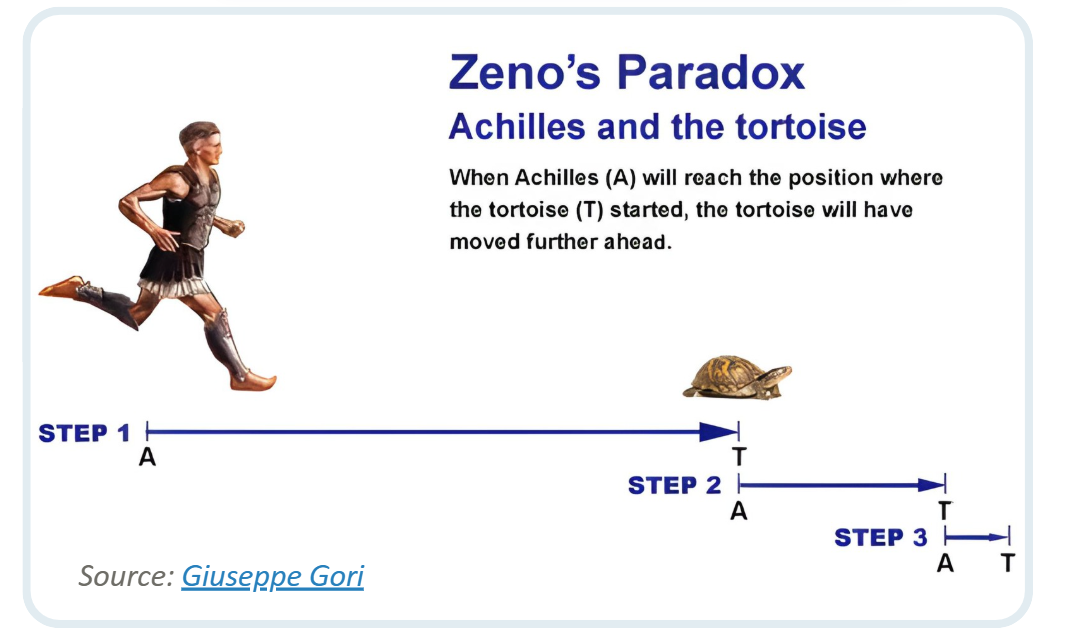
Another Greek philosopher, Eubulides, from the 4th century BCE, came up with an even more provocative paradox: What I am saying now is a lie. Or more simply: I am lying. If the statement is true, then it must be false, and if it is false, then it must be true, resulting in a contradiction.In addition to Epimenides and Eubulides, perhaps the most famous Greek philosopher remembered for his paradoxes is Zeno of Elea (from Mykonos), some of which remain well-known, like Achilles and the Tortoise. In this paradox, Achilles races a tortoise, giving it a 100-meter head start. If the tortoise moves ten times slower than Achilles, and Achilles halves the distance between them every 10 seconds, the tortoise continues advancing slightly with each interval. Achilles gets ever closer but theoretically never overtakes it.
A related paradox is Zeno’s Arrow: If everything occupying a space at a given moment is stationary, and a moving object also occupies a space in any given instant, then a flying arrow must be motionless. Since it cannot be in two places at once and time is infinitely divisible, the arrow theoretically never reaches its target.
Finally, let us mention a well-known paradox that challenges modern physics: the so-called Twin Paradox.
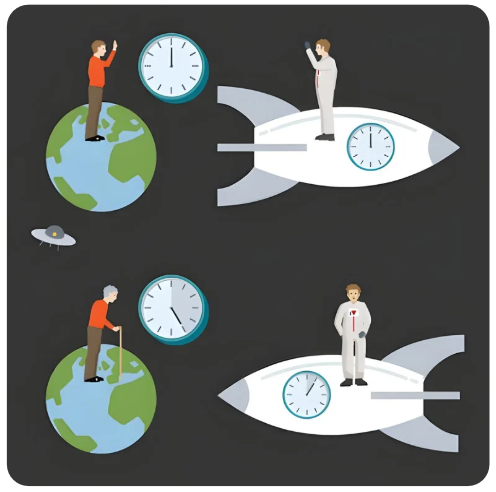 Imagine two twins, one of whom embarks on a cosmic journey aboard a spaceship while the other remains on Earth. Because time is relative, for the twin traveling in the spaceship at a speed close to the speed of light, time slows down.
Thus, when the traveling twin returns to Earth after 20 years, they will appear noticeably younger than their twin sibling. For the traveling twin, only about 10 years might have passed, while 20 years would have passed for the sibling who stayed on Earth.
As strange as it may sound, this outcome is entirely consistent with the theory of relativity!
Why Do We Fall for Logical Fallacies?
We fall prey to logical fallacies because of inherent cognitive biases and emotional influences that distort our reasoning. Cognitive biases, such as confirmation bias, lead us to favour information that aligns with our existing beliefs while ignoring evidence to the contrary, making flawed arguments appear convincing. Additionally, our reliance on mental shortcuts (heuristics) to process complex information quickly can result in oversimplifications and errors in judgement. Emotional influences, such as fear, anger, or excitement, further cloud our thinking by overriding rational analysis with impulsive reactions. Social pressures, like the desire to conform or gain approval, also play a role, making us more likely to accept popular yet flawed arguments. Furthermore, fallacies often exploit persuasive language or exploit gaps in our knowledge, making it harder to detect errors. Understanding these tendencies is essential for recognizing and resisting fallacies, enabling clearer, more rational decision-making.
- Straw Man Fallacy: Misrepresenting someone's argument to make it easier to attack.
-
Please find here the PowerPoint presentation for Lesson 12, entitled Logical Fallacies: Spotting and Avoiding Flawed Reasoning.
-
- Thou Shall Not Use Logical Fallacies – a useful website with posters, cards, information on logical fallacies.
- Your Bias Is – a website with posters, information on cognitive biases.
- PRECOBIAS – pedagogical resources: a project featuring lesson plans on critical thinking and cognitive biases.
-
Practise your knowledge about Logical Fallacies by taking this short, 10-question quiz.
-